What the research says
In Russia, 62 in 100 adults tested in the fall had low vitamin D. In the spring, 84 did
This is the result of Russia's first vitamin D registry, a large collection of blood tests done under one set of rules. In 2020, 996 volunteers aged 18 to 50 from ten regions of the country gave blood, some in the fall and some in the spring. Low meant a level under 30 nanograms per milliliter (ng/mL), as in the 2015 guidelines of the Russian Association of Endocrinologists. It is fall again now, the days are getting shorter, and winter is ahead. Below we look at why vitamin D in blood tests is lowest at the end of winter and in spring, why your body needs it, how much you need, and what is known about its usual companions, K2 and magnesium.
01Fall
The shorter the day, the less sun your skin gets
In October you see it every day. It gets light later and dark earlier, the sun sits low even at noon, and we go outside in coats and scarves and hurry back to the warmth.
For vitamin D this is no small thing. It is called the sunshine vitamin because your skin makes it in sunlight, or more exactly in one part of it, ultraviolet B rays. The European Food Safety Authority (EFSA) says that while your skin is making it, you need less vitamin D from food, and sometimes you need none from food at all.
According to EFSA, how much vitamin D your skin makes depends on latitude and season, clouds, how much time you spend outdoors, clothing, sunscreen, skin color and age. In the fall several of these change against us at once. The days are shorter, there are more cloudy days, we wear more clothes and spend less time outside.
Researchers in Russia checked whether this shows up in the blood. People gave blood in different regions and different months of the year, and below is what the tests showed.
What people say online
- “Then one sunny morning comes along. That's it, I'm happy.”
- “From the end of January until early March I'm basically hibernating, everything takes effort. In spring and summer I'm a normal person.”
- “How come I live in the south and still don't have enough vitamin D?”
- “I take supplements, I get some sun (not much, honestly), but the deficiency is still there.”
- “Feels like literally everyone has a vitamin D deficiency these days.”
- “I'll add that you need magnesium in the evening. If you're low on it, vitamin D doesn't get absorbed.”
02Blood tests
From fall to spring, vitamin D in blood tests goes down
Your vitamin D supply is judged by a blood test for 25(OH)D, the main form of vitamin D that circulates in the blood. The 2015 guidelines of the Russian Association of Endocrinologists call a level of 30 ng/mL or higher adequate, 20 to 30 ng/mL insufficiency, and under 20 ng/mL deficiency.
The registry we mentioned at the start used these rules. In the fall, insufficiency or deficiency was found in 62 participants out of 100, in the spring in 84, and across both seasons together in 72. The authors write that low vitamin D is found everywhere and is linked not to the region but, to some degree, to the time of year. Participants were recruited at the medical offices of the Invitro lab, and the study was paid for by the company Akrikhin.
The same seasonal shift shows up in the Invitro archive, which holds tests from 30,040 adults from 2013 to 2018. In summer and fall the level was on average 15% higher than in winter and spring, and only 24 people out of 100 had a sufficient level of 30 ng/mL or more. There is an important caveat here. These were people who came to the lab on their own, and we don't know why they decided to check their vitamin D. To draw conclusions about the whole country, the authors write, you need a random sample of the population.
The Omsk region showed where the lowest point on this path is. Researchers tested 2,586 adults aged 18 to 93, chosen so that by sex, age and place of residence they represented the region's adult population. Low values came in winter and spring, with the lowest in March, when the median was 18.4 ng/mL. The median means that half of the people tested had a level below this number.
In Europe, researchers pooled tests from 55,844 people and counted how many had a very low level, under 12 ng/mL (30 nmol/L). Among those who gave blood during the long winter from October to March, it was found in 17.7%, and among those tested in summer in 8.3%. So in these tests fall is only the start of the decline, and the lowest point comes at the end of winter and in spring.
The full ingredient list of the vitamin D3 with K2 from our catalog is on a separate page.
See the vitamin D03Why your body needs it
Without vitamin D, your body absorbs less calcium from food
To understand what a shortage means, it helps to remember why your body needs vitamin D. In the gut it helps absorb calcium and phosphorus from food, and bone is built from them. Both EFSA and Rospotrebnadzor, Russia's federal consumer health agency, agree on this.
When vitamin D runs short, calcium and phosphorus from food are poorly absorbed, and bone is mineralized less well. If the shortage gets to the point of clear symptoms, in adults this is osteomalacia, a softening of the bones. Rospotrebnadzor adds that a lack of vitamin D speeds up mineral loss from bone and raises the risk of osteoporosis.
In the European Union, a few other things may be said about vitamin D. It contributes to the normal function of muscles and the immune system. These are careful words about the role of a nutrient in the body, not a promise that an extra pill will make a healthy person stronger.
Beyond bones and muscles, EFSA writes, there is not yet enough data to set intake values on. So below we separate what is firmly known from the hopes people place on vitamin D.
04Where normal ends
How many people fall short depends on where you draw the line
The numbers 62 and 84 out of 100 come from one cutoff. Both the registry and the Invitro archive counted a level of 30 ng/mL or higher as sufficient.
Other experts draw the line lower. When EFSA worked out how much vitamin D people need each day, it aimed for a blood level of 50 nmol/L, which is 20 ng/mL. A committee of the U.S. Institute of Medicine also set the daily intake for a level of at least 20 ng/mL and writes that this intake covers the needs of at least 97.5 people out of 100. The same committee believes that vitamin D shortage in North America has been overestimated.
In its 2024 guideline, the Endocrine Society in the US found no clear data on what blood level is needed to prevent disease.
So with the strict line of 30 ng/mL, more people come out as falling short than with the softer line of 20 ng/mL. But the argument about the line doesn't change the main point. In the Omsk region in March, half of the people tested had a level below 18.4 ng/mL, which is below both lines.
People argue about where normal ends, but how much vitamin D is in a tablet you can know for sure. The full ingredient list of the vitamin D3 with K2 from our catalog is on a separate page.
See the vitamin D05Food and supplements
When there's little sun, that leaves food and supplements
We already know from EFSA that while your skin makes vitamin D, you need less of it from food. In fall and winter your skin gets little sun, and then what comes from food matters more.
The number on your test doesn't stay put either. According to EFSA, the amount of 25(OH)D in the blood drops by half in about 13 to 15 days.
Getting enough vitamin D from natural foods alone is hard. The Endocrine Society writes that few natural foods are rich in vitamin D, so you can get it from fortified foods and supplements.
Finland showed what this looks like across a whole country. From 2000 to 2011, the average vitamin D level in adults there rose from 48 to 65 nmol/L. The authors explain the rise mainly by food fortification, especially of liquid dairy products, and also by the share of people taking supplements growing from 11% to 41%.
06Trials
In trials, vitamin D did not shield people from fractures and colds
Since a shortage is so common, the answer seems simple. Everyone takes vitamin D, and lots of it, and then there are no fractures and no colds. This was tested in trials where some people got vitamin D and others got a placebo.
A Cochrane review pooled trials in women after menopause and older men. Cochrane is an international organization that collects and checks medical research. Vitamin D on its own, in the forms and doses tested, is unlikely to prevent hip fracture (11 trials, 27,693 people) or any new fracture (15 trials, 28,271 people). Taken with calcium, it lowered the risk of hip fracture slightly. For older people living at home, that meant one fewer fracture per 1,000 people a year.
In the American VITAL trial, generally healthy middle-aged and older people who were not chosen for a shortage got vitamin D3 or a placebo. Fractures happened in 769 of 12,927 people in the vitamin group and in 782 of 12,944 on the placebo, almost the same, and the trial found no significant difference.
A combined analysis of dozens of trials, called a meta-analysis, came to the same result. Vitamin D changed neither the number of fractures (36 trials, 44,790 people) nor the number of falls (37 trials, 34,144 people), and higher doses were no different from lower ones.
So where does the belief that vitamin D protects bones come from? In observational studies, which simply compare people, those with more vitamin D in their blood have fewer fractures. But in trials, vitamin D alone did not reduce fractures, and together with calcium there were 6% fewer. A link in observational studies doesn't yet prove that the vitamin itself is the cause.
The story with colds is similar, and it is worth remembering in the fall. In 2021, a meta-analysis of 37 trials found that vitamin D gave a small protection against acute respiratory infections. In 2025 it was updated, and across 40 studies with 61,589 participants no significant protection was left. Vitamin D is still a nutrient your body needs, but it is not a shield against fractures and colds.
Your body needs vitamin D, even though it doesn't work miracles. Below we look at the trials on its usual companions, K2 and magnesium. The ingredients of the vitamin D3 with K2 from our catalog are listed on a separate page.
See the vitamin D07D3 and K2
The D3 and K2 pair was tested, and not everything people say about it held up
K2 is one form of vitamin K, and MK-7 is one type of K2 that is also sold as a supplement. K2 is often sold together with D3, and the reason given is simple. You need vitamin D to absorb calcium, and K2 supposedly sends that calcium into your bones instead of your blood vessel walls. It sounds logical, and it has been tested.
A meta-analysis of 8 trials with 971 people showed that vitamin K together with vitamin D slightly raises bone mineral density, which is how packed the bone is with minerals. The conclusion of this work is about bone density and says nothing about fractures.
A 2019 review of vitamin K trials is more cautious. In women after menopause and people with osteoporosis, the authors found no evidence that vitamin K affects bone density. Clinical fractures may become less common, but there is not enough data for a firm conclusion, and the integrity of some earlier data has been questioned.
The main promised benefit, protecting blood vessels, was tested in older men who already had calcium deposits on their aortic valve. For two years they took 720 mcg of K2 as MK-7 together with 25 mcg of vitamin D, or a placebo. Calcium deposits in the aorta and the heart's arteries grew in both groups with no significant difference.
K2 also has one important feature. It changes how blood thinners from the vitamin K antagonist group work. In a study of healthy volunteers, this was noticeable in some people at just 10 mcg of K2 a day, and the authors advise people taking these drugs to avoid supplements with K2.
08Magnesium
Magnesium and vitamin D are linked, but not as tightly as people say
People are even more certain about magnesium. They say vitamin D isn't absorbed without it. The idea grew out of test tube and animal experiments, where the enzymes that make and break down vitamin D depended on magnesium. Results like these don't carry over to people directly.
In people, the effect of magnesium on vitamin D levels was tested in a trial. If the starting vitamin D level was close to 30 ng/mL, magnesium raised it, and if it was higher, up to about 50 ng/mL, magnesium lowered it. The authors write carefully that enough magnesium may be important for a normal vitamin D level.
In another small trial in people with excess weight, magnesium together with vitamin D3, as the authors concluded, may raise the vitamin D level more than D3 alone. Both studies are small, and both are about the vitamin D level in the blood.
The European list of permitted claims says that magnesium contributes to the normal function of the nervous system and muscles and to the reduction of tiredness. There is no claim on this list that magnesium helps vitamin D work.
At the same time, your body needs magnesium on its own. Under Rospotrebnadzor's Russian norms an adult needs 420 mg of magnesium a day, and under EFSA's values men need 350 mg and women 300 mg.
Your body needs magnesium on its own, and vitamin D in supplements often comes paired with K2. The full ingredient list of the vitamin D3 with K2 from our catalog is on a separate page.
See the vitamin D09Myths
What people believe and research did not confirm
- Myth
Summer gives you enough vitamin D to last until spring
FactIn the Omsk region, the lowest blood vitamin D levels were in winter and spring, with the lowest in March, when the median was 18.4 ng/mL.
Source 03 - Myth
A vitamin D pill protects you from fractures
FactA Cochrane review found that vitamin D on its own is unlikely to prevent hip fracture or any new fracture. Only vitamin D together with calcium lowered the risk of hip fracture slightly.
Source 12 - See the vitamin D
- Myth
Vitamin D protects you from colds
FactAn updated 2025 meta-analysis of 40 studies with 61,589 participants found no significant protection against acute respiratory infections.
Source 16 - Myth
You can't get too much vitamin D
FactVitamin D has an upper level for adults, 100 mcg a day. This is the limit up to which EFSA does not expect harm from daily intake.
Source 07 - See the vitamin D
- Myth
K2 moves calcium out of your blood vessels
FactIn older men who already had calcium deposits on their aortic valve, two years of K2 with vitamin D did not change the growth of calcium deposits in the aorta and heart arteries compared with a placebo.
Source 21 - Myth
Vitamin D isn't absorbed without magnesium
FactIn a trial in people, magnesium raised the vitamin D level when it was close to 30 ng/mL and lowered it when it was higher, up to about 50 ng/mL. The authors only write that magnesium may be important.
Source 17
10What to do
What to do this fall and winter
Know your daily amount
Under Rospotrebnadzor's Russian norms, an adult needs 15 mcg of vitamin D a day, which is 600 IU (international units), and after age 65 it is 20 mcg, or 800 IU. The European value for adults is also 15 mcg, and the American one is 600 IU up to age 70 and 800 IU after that.
Remember the upper limit
For adults, EFSA set the upper level of vitamin D at 100 mcg a day from all sources combined. One microgram equals 40 IU, so that is 4,000 IU. This is the limit up to which EFSA does not expect harm from daily intake, not a recommended dose.
Get tested if your doctor advises it
The Endocrine Society does not advise testing everyone for vitamin D, because there is no clear level to raise it to for preventing disease. Decide with your doctor whether you need the test.
Think about vitamin D in the fall, not in March
In the Omsk tests vitamin D was lowest in March, and in the European tests low levels were found more often in people who gave blood from October to March. If you are thinking about a supplement, it is easier to talk it over with your doctor now, in the fall, than at the end of winter.
If you decide to take a supplement
The Endocrine Society names fortified foods and supplements as a way to get vitamin D, since few natural foods contain it. Vitamin D is sold on its own and paired with K2, and magnesium comes as separate tablets. Decide with your doctor which supplement to choose and at what dose.
If you decide to add vitamin D to your diet, everything about the vitamin D3 with K2 from our catalog is on a separate page.
See the vitamin D11Sources
What the sources actually say
The first multicenter registry study of vitamin D in Russia. Participants were volunteers aged 18 to 50, recruited at the medical offices of Invitro LLC. Over spring and fall 2020, 996 people from 10 regions were included. Following the 2015 guidelines of the Russian Association of Endocrinologists, a 25(OH)D level of 30 ng/mL or higher was considered adequate, 20 to 30 ng/mL insufficiency, and under 20 ng/mL deficiency. Deficiency and insufficiency were found in 72.1% of those tested, in 84.2% in spring and 62.4% in fall. Low vitamin D status was not linked to the region of residence but depended to some degree on the season. The study was funded by JSC Akrikhin.
Tests from 30,040 people aged 18 and older at the commercial lab InVitro (2013–2018). The reasons people got tested are unknown. A sufficient level (30 ng/mL or higher) in 24.2%, 10 to 19.9 ng/mL in 34%, under 10 ng/mL in 5.6%. In summer and fall the level was 15% higher than in winter and spring. The authors write that representative data from a random sample are needed.
2,586 adults aged 18 to 93 were tested. The sample, built on quotas by sex, age and place of residence, represents the adult population of the Omsk region. Low values in winter and spring, the lowest in March, median 18.4 ng/mL.
13.0% of 55,844 Europeans had a 25(OH)D level under 30 nmol/L (12 ng/mL) on average over the year, 17.7% among those tested during the extended winter from October to March, and 8.3% in summer.
- See the vitamin D
In Finland from 2000 to 2011, the average 25(OH)D level in adults rose from 48 to 65 nmol/L, and the share taking vitamin D supplements rose from 11% to 41%. The rise is explained mainly by food fortification, especially of liquid dairy products, and by more frequent supplement use.
The vitamin D intake value for adults is 15 mcg a day, and the target 25(OH)D level for the values is 50 nmol/L. Vitamin D3 production in the skin is affected by latitude, season, the ozone layer and clouds, time outdoors, sunscreen, clothing, skin color and age. When the skin makes vitamin D, the need for it from food is lower or may be zero. 25(OH)D is the main form of vitamin D in the blood, with a half-life of about 13 to 15 days. In the gut, vitamin D helps absorb calcium and phosphorus. Deficiency leads to impaired bone mineralization and in adults shows up as osteomalacia. Data on benefits outside the musculoskeletal system are not enough to set intake values. The magnesium value is 350 mg for men and 300 mg for women.
The tolerable upper intake level is the highest daily intake over time from all food sources at which no risk to health is expected. For vitamin D in adults it is 100 mcg a day.
The recommended vitamin D intake is 600 IU a day at ages 1 to 70 and 800 IU from age 71, which corresponds to a 25(OH)D level of at least 20 ng/mL (50 nmol/L) and covers the needs of at least 97.5% of the population. The committee believes the prevalence of vitamin D shortage in North America has been overestimated.
- See the vitamin D
The functions of vitamin D are linked to maintaining calcium and phosphorus metabolism and the mineralization of bone tissue. A lack of vitamin D increases demineralization of bone tissue and raises the risk of osteoporosis. The adult requirement is 15 mcg (600 IU) a day, over age 65 it is 20 mcg (800 IU). The adult requirement for magnesium is 420 mg a day.
There are no data supporting routine 25(OH)D testing and no clear optimal level for preventing disease, so routine testing is not advised. Few natural foods are rich in vitamin D, so it can be obtained from fortified foods and supplements.
Claims permitted in the EU. Vitamin D contributes to normal absorption and use of calcium and phosphorus, maintenance of normal bones, and normal function of muscles and the immune system. Magnesium contributes to normal function of the nervous system and muscles and to the reduction of tiredness and fatigue. There is no claim that magnesium helps vitamin D work among the entries for magnesium and vitamin D.
In women after menopause and older men, vitamin D alone is unlikely to prevent hip fracture (11 trials, 27,693 participants) or any new fracture (15 trials, 28,271 participants). Vitamin D together with calcium slightly lowers the risk of hip fracture, among those living at home by one fewer fracture per 1,000 older people a year.
- See the vitamin D
In a pooled analysis, vitamin D did not affect total fractures (36 trials, 44,790 people), hip fractures or falls (37 trials, 34,144 people). There was no difference between higher and lower doses.
In observational studies, a higher 25(OH)D level is linked to a lower risk of fractures. In trials, vitamin D alone did not lower fracture risk, and vitamin D together with calcium lowered the risk of any fracture by 6%.
The VITAL trial in the US. Compared with placebo, vitamin D3 had no significant effect on the number of fractures (769 of 12,927 and 782 of 12,944 participants) in generally healthy middle-aged and older people who were not selected for vitamin D deficiency.
A 2021 meta-analysis of 37 trials showed a small protective effect of vitamin D against acute respiratory infections. In the update across 40 studies with 61,589 participants, there was no statistically significant protection (odds ratio 0.94).
- See the vitamin D
According to test tube and animal studies, the enzymes that make and break down vitamin D depend on magnesium. In the trial, magnesium raised the 25(OH)D3 level when the starting level was about 30 ng/mL and lowered it when it was higher (about 30 to 50 ng/mL). The authors suggest that optimal magnesium status may be important for the vitamin D level.
In people with overweight and obesity, taking magnesium and vitamin D together may raise the 25(OH)D level more than vitamin D alone.
A meta-analysis of 8 trials, 971 participants. Vitamin K together with vitamin D significantly increased total bone mineral density.
In women after menopause and people with osteoporosis, there is no evidence that vitamin K affects bone density or vertebral fractures. It may reduce clinical fractures, but there are not enough data to confirm this. The integrity of some earlier data has been questioned.
- See the vitamin D
Older men with aortic valve calcification took 720 mcg of MK-7 and 25 mcg of vitamin D a day, or a placebo, for 24 months. Progression of calcification of the valve, the aorta and the coronary arteries did not differ significantly.
In healthy volunteers taking an anticoagulant from the vitamin K antagonist group, MK-7 supplements even at 10 mcg a day significantly changed sensitivity to the drug in some people. The authors write that patients taking vitamin K antagonists should avoid MK-7 supplements.
12Products
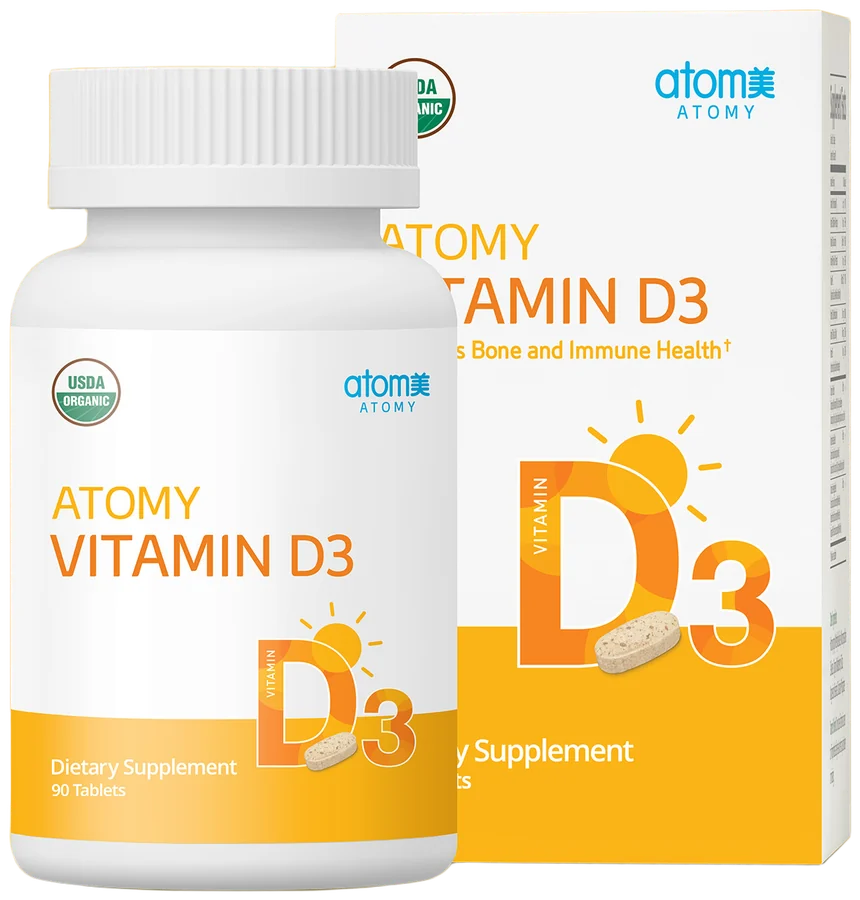
Vitamin D3 from our catalog
- A90177
Atomy Vitamin D3
2000 IU of vitamin D3 (cholecalciferol), with vitamin K2 and an organic mushroom blend. Certified USDA Organic, Non-GMO Project Verified, Halal Certified.
Description from the product page on us.atomy.com
Learn more
13Sign up
If you decide to buy, choose the country where you live
Sign-up and purchase happen on the Atomy website; we do not sell products, and Yandex Metrica counts visits only if you agree.