What the research says
How often to replace your kitchen sponge
The holidays are coming with lots of cooking, and the sponge by the sink will be working every day. In a study of 22 homes it was the most contaminated of the 26 items tested, and you can't tell that by looking at it. Below we look at how often to replace a kitchen sponge, whether the microwave helps and which is better, a sponge or a brush.
01The worry
People use a sponge until it falls apart
There's a sponge by the sink in almost every home, and it gets used several times a day. People usually replace it when it tears, turns dark or starts to smell. Some keep one sponge for a month, some for six months, and the advice to swap it every week sounds strange to a lot of people.
Microbiologists have been studying dish sponges for a long time, though. NSF, an American organization that certifies household products, tested 26 items in 22 homes. The most contaminated of them was the kitchen sponge, followed by the toothbrush holder.
We pulled together what's known about sponges from studies and from official guidance in Germany, the UK and Russia. The studies took sponges from real kitchens or tested them in the lab, and no study looked at illness in people. Still, they show why you can't judge a sponge by its looks and how often to replace it.
What people say online
- “Until it falls apart.”
- “I change it when it starts looking ugly lol”
- “A warm wet thing full of grease, what could go wrong?”
- “Sponges are easy. Stick it in the microwave for one minute and it's sterile again.”
- “Just read you're supposed to replace your dish sponge once a week.. who actually does that lol”
- “use it till it wears out, the dish soap disinfects it anyway lol”
02Bacteria
Why there are so many bacteria in a sponge
After you wash the dishes, bits of food stay in the sponge. The UK Food Standards Agency (FSA) explains that bacteria grow on dirty, damp things. A fact sheet from NSF says sponges rarely get a chance to dry properly, and that makes them the ideal environment for germs.
German microbiologists counted how many bacteria live there. They took 14 used sponges from homes, read the DNA of the bacteria living in them and looked at the sponges under a microscope. In all, they found 362 groups of bacteria. In some spots the density reached 54 billion cells per cubic centimeter of sponge. That's the density in the most crowded spots, not the average for the whole sponge.
In another study, Norwegian and Portuguese scientists collected sponges used by their colleagues, students and family members. In the Portuguese sponges the median, the middle value when all results are lined up, was over ten billion bacteria per sponge.
American researchers checked whether the bacteria in sponges are alive. In five sponges the bacteria were mostly alive, and every sponge had E. coli and Staphylococcus aureus. This study can't tell us whether these particular bacteria are dangerous.
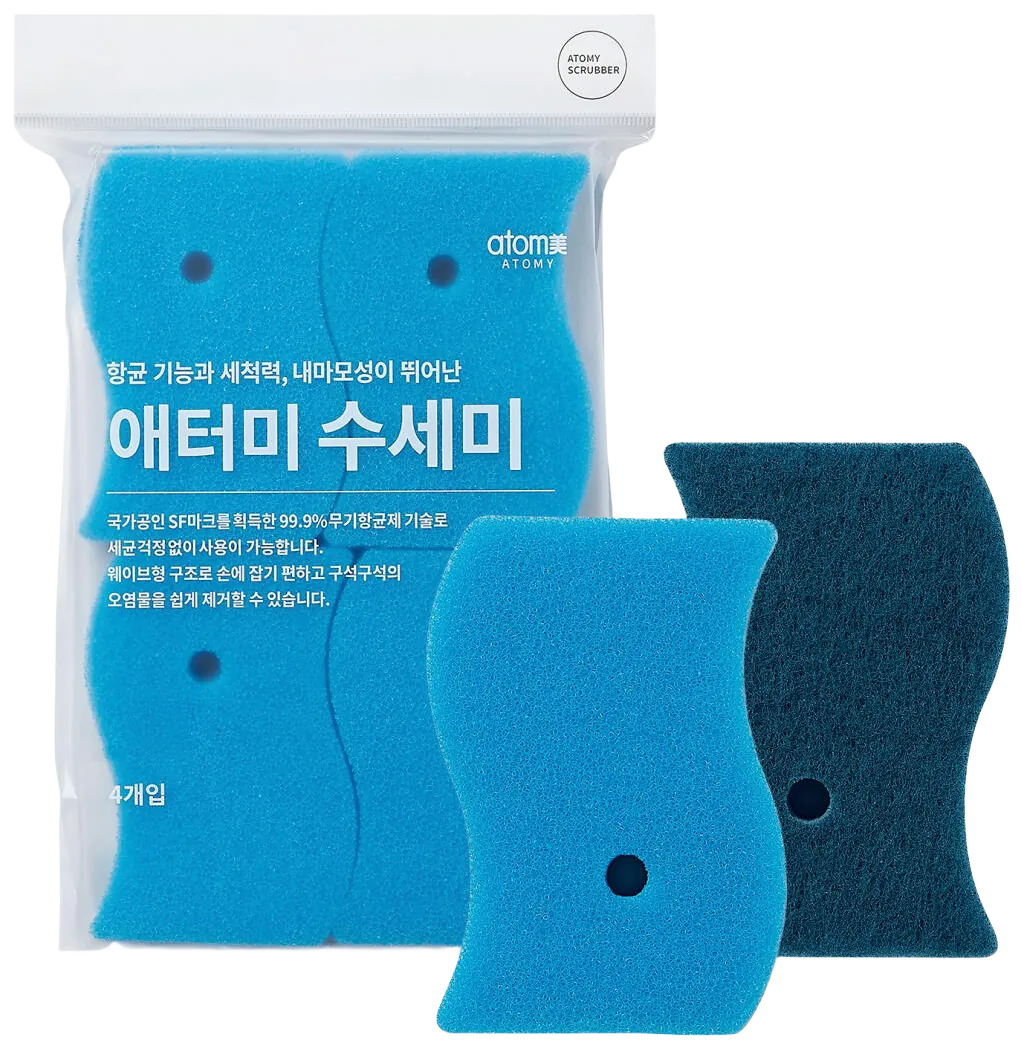
Every day a sponge deals with food and grease on your plates. The sponge in our catalog has a porous layer that washes away leftover grease without scratching your dishes.
See the sponge03The kitchen
How a sponge spreads bacteria around the kitchen
Sponges aren't used just for dishes. Students living in dorms at a university in the United Arab Emirates were asked what else they cleaned with their dish sponge. The oven was named by 32% of them, the sink by 26% and the fridge by 10%, and 4% used it to wipe up spills on the floor.
What gets into a sponge moves on from there. A Brazilian study checked how many bacteria sponges from food service kitchens leave on stainless steel and plastic. Thousands to hundreds of thousands of bacteria were left on every square centimeter, and a day later some of them were still alive. In the lab at Germany's Federal Institute for Risk Assessment (BfR), a light press with a colonized sponge moved up to 100,000 bacteria onto a surface.
In Philadelphia, researchers took samples in 100 home kitchens. On sponges and dishcloths they looked for fecal coliforms, bacteria used as a sign of contamination, and for Staphylococcus aureus. When these turned up on a sponge or cloth, they were also more often found on other kitchen surfaces, and S. aureus was found most often on countertops and fridge handles. The authors call sponges and cloths both a reservoir and a carrier of bacteria.
There's no direct answer on whether this is dangerous for people. The German microbiologists don't know of a single case where infection with the bacteria found in their sponges was directly linked to the home. British scientists recreated dishwashing in the lab, and the sponges in their experiments often picked up pathogens, but bacteria rarely moved from dishes to food.
The findings also vary. None of 98 Italian sponges had Salmonella or two other foodborne pathogens. But in an American study of 10 kitchens, E. coli was in one out of three sponges.
Scientists in six European countries watched 87 families cook chicken with vegetables and looked for Campylobacter bacteria in the kitchen. It spread to other kitchen surfaces or to sponges and cloths in five homes. The authors think infectious doses are probably rarely passed on this way.
04When to replace
How to tell it's time to replace your sponge
Not by its looks or smell. The same BfR institute tested this in the lab on pieces of sponge. Smell and color change weren't linked to the number of germs, and the authors write that deciding when to replace a sponge by eye is unreliable.
Italian public health doctors saw the same thing in 98 sponges from homes. They found no link between the condition of a sponge and its contamination, and looking at it wasn't a reliable sign. Norwegian scientists add that neither the owners' habits nor the makeup of the household explained the difference in bacteria counts between sponges.
It's also known where the bacteria come from. German microbiologists looked for them in new, unused sponges in three ways, by DNA, under a microscope and by growing them on a culture medium, and found none with any method. Everything that lives in a sponge later gets into it in the kitchen.
Bacteria grow fast in a sponge. In the BfR experiments, E. coli and Salmonella colonized a piece of sponge up to about a billion cells and stayed there for at least two weeks. Ordinary bacteria that don't cause disease also grew to about a billion per sponge in the Norwegian scientists' experiment.
That's why the time to replace a sponge is tied to the calendar, not to how it looks. Neither Germany's Federal Ministry of Health nor the UK's FSA sets an official replacement schedule, and scientists from Germany suggest replacing your sponge, for example, once a week.
The advice to replace a sponge on schedule applies to any sponge, antibacterial ones too, so it helps to keep a new one on hand. The sponges in our catalog come four to a pack, with an antibacterial treatment that protects the sponge itself and Korea's SF hygiene mark.
See the sponge05Cleaning
Does microwaving a sponge disinfect it
Some people heat their sponge in the microwave and consider it sterile after that. In the lab, the microwave really does kill almost all the bacteria. In an experiment by the U.S. Department of Agriculture, sponges were inoculated with bacteria and treated in different ways. Untreated sponges still had tens of millions of bacteria, and after one minute in the microwave on full power almost none were left. The dishwasher also cut their number sharply.
University of Florida scientists tested the microwave on sponges they had deliberately contaminated with wastewater. E. coli died within 30 seconds and more than 99% of all bacteria within one to two minutes, while the toughest ones, bacterial spores, needed 4 minutes.
In homes it's a different story. German microbiologists compared sponges that their owners regularly sanitized with the rest. The "cleaned" sponges didn't have significantly fewer bacteria. The authors suggest that resistant bacteria survive the cleaning and quickly take over the sponge again.
The same group gave new sponges to 20 participants for about four weeks. Ten of them heated the wet sponge for one minute on full power two or three times a week. By the end, the mix of bacteria in these sponges had shifted, but whether that's better or worse for hygiene will take more research to show, the authors say.
So scientists disagree. In experiments, Norwegian scientists saw boiling, chlorine and the dishwasher noticeably reduce Salmonella in sponges, and they think this kind of cleaning may be a safe alternative to a new sponge. The German microbiologists lean toward replacing the sponge regularly.
06Drying
Which is better for dishes, a sponge or a brush
Norwegian scientists ran experiments with sponges and dish brushes. The brushes dried the fastest, and the bacteria in them died off over time, with no Salmonella found after three days. In two of the three types of sponges, Salmonella survived for more than a week, and in the slowest-drying sponge it was already growing on the first day.
The authors' conclusion is direct. Brushes are more hygienic than sponges and should be used more often. In a later study the same group explained the difference. A brush often has time to dry between washes, while a sponge you use every day is hard to dry.
Official guidance says the same thing. Germany's Federal Ministry of Health writes that sponges are less suitable for hygiene reasons, and if you do use them, it's important to replace them regularly. It advises washing synthetic dish brushes in the dishwasher and replacing them from time to time. The Ivanovo Region office of Rospotrebnadzor, Russia's public health agency, goes further and doesn't recommend washing dishes with sponges at all, because they can't be properly cleaned.
Drying matters for the sponge itself too, though it can't fully clean it. In the BfR lab, the number of pathogens didn't drop after three days of drying. Norwegian and Portuguese scientists added Salmonella to sponges from homes. Sponges that, according to their owners, dried between washes held fewer bacteria on average, but they didn't hold less Salmonella.
If you wash dishes with a sponge, leave it after washing where it can dry before the next time. The porous layer of the sponge in our catalog dries fast.
See the sponge07Myths
Dish soap, bleach and other sponge myths
- Myth
Dish soap disinfects your sponge while you wash
FactDutch scientists tested an antibacterial dish soap. In a solution it reduced pathogens, but in used sponges with food residue it didn't significantly reduce them within 24 hours. The same was true for sponges that were simply used for dishes at home. Only one product was tested.
Source 20 - Myth
A sponge is 200,000 times dirtier than a toilet
FactWe didn't find that number in any source we read. There is an NSF study where the kitchen sponge came out as the most contaminated of 26 items in 22 homes. Coliforms, bacteria used as a sign of contamination, were found most often in the kitchen, on sponges, sinks and cutting boards.
Source 01 - See the sponge
- Myth
Soak your sponge in bleach and it's clean again
FactIn a U.S. Department of Agriculture experiment, sponges soaked in a 10% bleach solution had only slightly fewer bacteria than sponges from plain water or lemon juice. What works in bleach is chlorine, and the authors explain that leftover meat and protein in the sponge neutralize it.
Source 09 - Myth
A sponge with silver doesn't collect bacteria
FactNorwegian and Portuguese scientists gave participants antimicrobial sponges with silver. After 4 weeks of use, they were no different from regular sponges in either bacteria count or variety. The authors don't rule out that a new sponge like this has an antimicrobial effect at first. Only one silver sponge was tested.
Source 04
Until it's time to replace it, your sponge works every day. The polyurethane layer of the sponge in our catalog makes a rich lather and wears down slowly.
See the sponge08What to do
How often to replace your kitchen sponge and how to care for it
Replace your sponge regularly, for example once a week
Germany's Federal Ministry of Health writes that it's important to replace sponges regularly, and German microbiologists suggest replacing yours, for example, once a week. Don't wait for a smell or holes, because you can't tell how contaminated a sponge is by its looks.
Let your sponge dry
The UK's FSA advises washing and drying sponges and cloths before you use them again, because bacteria grow on dirty, damp things.
Keep a separate sponge for counters and the sink
The FSA advises using different cloths for different jobs, one for surfaces and another for washing dishes. The Ivanovo Region office of Rospotrebnadzor also writes about separate sponges for the sink.
Clean your sponge, but replace it on schedule
In the lab, one minute in the microwave and the dishwasher killed almost all the bacteria in a sponge. But in homes, regularly cleaned sponges were no cleaner than the rest, so cleaning doesn't cancel the replacement schedule.
Wipe down counters soon after food has been on them
In an American study of 10 kitchens, disinfectant used now and then didn't consistently reduce contamination. Contamination dropped sharply when surfaces were treated soon after contact with food or hands.
09Sources
What the sources actually say
26 everyday items in 22 homes. The kitchen sponge was the most contaminated item in the home, followed by the toothbrush holder. Coliforms were found most often in the kitchen, on sponges, sinks and cutting boards. From the NSF fact sheet, sponges and dishcloths are rarely allowed to dry properly, which makes them an optimal environment for germs. The authors are from NSF International.
We advise regularly washing or replacing dishcloths, tea towels, sponges and oven gloves. It's important to wash and dry them before using them again, because dirty, damp things help bacteria grow. Use different cloths for different jobs, one for surfaces and another for washing dishes.
14 used sponges from homes in Germany. They found 362 groups of bacteria that could be told apart by a gene. In some spots of a sponge the density reached 25 and 54 billion cells per cubic centimeter. Regularly sanitized sponges didn't show significantly fewer bacteria. In new, unused sponges no bacteria were found by DNA, under a microscope or by culture. The authors advise replacing sponges regularly, for example once a week, and don't know of a single case where infection with these bacteria was directly linked to the home.
Sponges and brushes from households in Norway and Portugal (a convenience sample of colleagues, students and their families). The median total bacteria count in Portuguese sponges was over ten billion per sponge. Owners' habits and household makeup didn't explain the difference between sponges. In the experiment with added Salmonella, the 38 sponges that, according to their owners, dried between uses had a significantly lower total bacteria count, but no less Salmonella. Regular and silver sponges didn't differ in bacteria count or variety after 4 weeks, and an initial effect in new antimicrobial sponges can't be ruled out. Brushes often have time to dry, while a sponge used every day is hard to dry. Salmonella in sponges didn't decrease with any storage method.
- See the sponge
Five used sponges. Each had three to six live foodborne pathogens, and E. coli and Staphylococcus aureus were found in the live community of every sponge. The bacterial communities of the sponges were mostly alive.
A lab model of a sponge. E. coli and Salmonella quickly formed stable populations of about a billion cells per piece of sponge. The pathogens persisted for at least 2 weeks and didn't decline after 3 days of drying. Contact with a surface under light pressure transferred up to 100,000 cells. Smell and color change aren't linked to the number of microbes, so deciding to replace a sponge by eye is unreliable. The authors are from Germany's Federal Institute for Risk Assessment (BfR).
98 household sponges. Campylobacter, Salmonella and Listeria weren't found in any sample. No significant link was found between the condition of a sponge and its contamination, and looking at it wasn't a reliable sign of contamination.
A survey of 9,966 consumers in ten European countries plus lab experiments. Bacteria that don't cause disease grew in sponges to about a billion per sponge. Salmonella survived for more than seven days in two of three types of sponges, and in the slowest-drying sponge it grew during the first day. Brushes dried the fastest. In brushes all bacteria died off over time, and Salmonella was no longer found after three days. Chlorine, boiling and the dishwasher noticeably reduced Salmonella. Brushes are more hygienic than sponges, and cleaning with chlorine, boiling or the dishwasher may be a safe alternative to replacing the sponge.
- See the sponge
A lab experiment by the U.S. Department of Agriculture. Untreated sponges still had tens of millions of bacteria, after one minute in the microwave on full power almost none were left, and the dishwasher also cut their number sharply. Sponges from a 10% bleach solution had only slightly fewer bacteria than sponges from water or lemon juice, because leftover meat and protein neutralize the chlorine in bleach.
Kitchen sponges and scrubbers were deliberately contaminated with wastewater and treated in the microwave on full power. The total bacteria count dropped by more than 99% within 1 to 2 minutes, coliforms and E. coli died after 30 seconds, and the toughest bacterial spores only after 4 minutes.
New sponges for 20 participants for about four weeks. Ten participants heated the wet sponge in the microwave for 1 minute on full power two or three times a week. The bacterial makeup of the treated sponges shifted, and whether these changes are helpful or harmful will be shown by further research.
50 sponges from student dorms (UAE). Sponges used for food contact surfaces were also used to clean the oven (32%), the sink (26%) and the fridge (10%) and to wipe up spills on the floor (4%).
- See the sponge
24 sponges from food service kitchens (Brazil). The sponges left on average thousands to hundreds of thousands of bacteria per square centimeter on stainless steel and polyethylene, and after 24 hours some of the bacteria on both surfaces were still alive.
Samples in 100 homes in Philadelphia. Contamination of a sponge or dishcloth with fecal coliforms or staphylococci predicted the same contamination of other kitchen surfaces, so sponges and dishcloths are both a reservoir and a carrier of bacteria. Staphylococcus aureus was found in 39% of homes, most often on countertops and fridge handles.
Experiments with a dishwashing model. Dish sponges often became contaminated with pathogens, and transfer from dishes to food was rare.
10 home kitchens in the U.S. E. coli was found in 33.3% of sponges. Disinfectant used now and then didn't give a lasting drop in contamination. When it was applied in a targeted way, soon after surfaces had contact with food or hands, contamination rates dropped sharply.
- See the sponge
Kitchens of 87 families in six European countries. Campylobacter spreading to other kitchen surfaces or to cleaning tools was found in five homes. Cross-contamination events that pass on infectious doses of pathogens appear to be rare.
For hygiene reasons, sponges are less suitable for this purpose. But if they're used anyway, it's important to replace them regularly. Dish brushes made of synthetic materials should be washed in the dishwasher and replaced from time to time.
Sponges and metal scrubbers aren't recommended for washing dishes, because they can't be properly cleaned. For the initial preparation of food, separate sponges are needed for cleaning the sink.
An antibacterial dishwashing liquid didn't significantly reduce microorganisms within 24 hours in used sponges with food residue, and the results were the same for sponges from everyday household use. In the test with a solution, the product did reduce pathogens.
10Products
Dish sponge from our catalog
- R00832
Atomy Scrubber (4 Pack)
A three-layer dish sponge with Korea's SF hygiene mark and an antibacterial treatment that protects the sponge itself. It washes away grease well.
Description from the product page on atomy.ru
Learn more
11Sign up
If you decide to buy, choose the country where you live
Sign-up and purchase happen on the Atomy website; we do not sell products, and Yandex Metrica counts visits only if you agree.