What the research says
Always tired? How to tell if you're low on iron and which blood test shows it. Your hemoglobin can be normal when your iron stores are already used up, and a ferritin test is what shows those stores
In November the days get shorter, and a lot of people feel tired from the moment they wake up, want to lie down in the middle of the day and can't seem to get enough sleep. One possible reason is low iron, since according to the WHO iron deficiency can lead to tiredness and lethargy. Below we look at how to tell if you're low on iron, why normal hemoglobin doesn't always mean you have enough iron and which blood tests to get.

01The worry
Always tired and sleepy even after a full night's sleep? It could be low iron
In the fall a lot of people notice that they get tired more easily. You want to lie down in the middle of the day, it's hard to focus, and even after a weekend the tiredness doesn't go away.
People who later found out they were low on iron describe it in a similar way. They wanted to sleep all the time, in the evening they just lay down and stared at one spot, and they blamed it on overwork, stress or depression. Some had normal hemoglobin, and their doctors told them there was nothing to worry about. Some admit they had never even heard of a ferritin test.
Low iron is more common than you might think. In the US, researchers checked 8,021 adults and counted who had ferritin, a marker of iron stores, below 30 ng/mL (the same as 30 mcg/L). Among women aged 18 to 50, 34% had depleted iron stores.
We didn't see a link between fall tiredness and iron in the sources, so for us November is just a reason to get checked. We gathered research on people, WHO documents, the Russian Ministry of Health clinical guidelines and advice from the NHS, the UK's national health service. Here we explain how to tell if you're low on iron and which test will show it.
02Iron stores
Low ferritin but normal hemoglobin, or iron deficiency without anemia
A lot of people judge their iron by the hemoglobin on a complete blood count. If hemoglobin is normal, it seems like you have enough iron.
But the Russian Ministry of Health clinical guidelines on iron deficiency anemia describe a separate condition called latent iron deficiency. Anemia means hemoglobin is below normal, and these guidelines consider 12 to 14 g/dL normal for women. Latent iron deficiency is when the body's iron stores are used up while hemoglobin stays normal. According to the same guidelines, it comes before anemia, and blood tests show low serum iron (iron in the liquid part of the blood) and low ferritin with normal hemoglobin.
Put simply, your iron stores run out before your hemoglobin drops. In a study of 8,200 non-pregnant women of reproductive age in the US, 17.3% had iron deficiency and 9.8% had anemia. From 1999 to 2023, iron deficiency didn't go down noticeably.
Normal hemoglobin doesn't mean your stores are full. The same Russian guidelines say that refilling iron stores is checked by ferritin, not by hemoglobin.
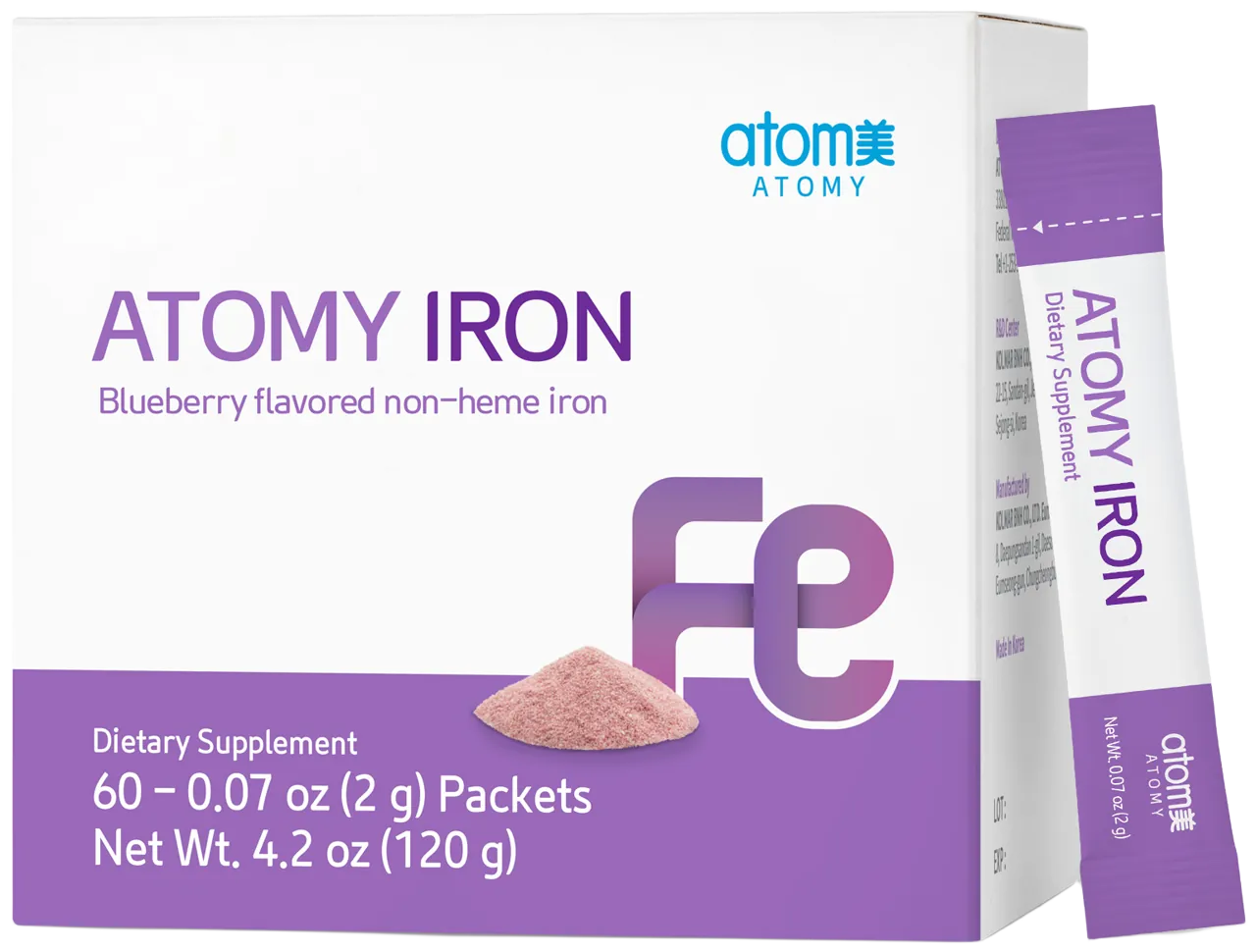
Iron is not naturally produced in the body, so you need to get it from what you consume. Whether you need a supplement is something to decide with your doctor. Our catalog has blueberry flavored iron in packets. One packet has 12 mg of iron, 67% of the daily value, and iron helps transport oxygen to body tissues by forming hemoglobin.
See the iron packets03Women
Why women are more likely to have low iron
Women need more iron than men. The NHS says women aged 19 to 49 need 14.8 mg of iron a day and men 19 and older need 8.7 mg. Russian intake norms from Rospotrebnadzor, the country's consumer health agency, show a similar gap, with 18 mg a day for women and 10 mg for men.
Doctors name the reason plainly. According to the Russian Ministry of Health guidelines, the main causes of iron deficiency anemia in women are heavy periods, pregnancy, childbirth and breastfeeding. The NHS also calls heavy periods a very common cause.
In that same study of 8,021 US adults, iron stores were most often depleted in women aged 18 to 50. The authors suggest heavy periods may be the reason. Yet only 22% to 35% of women who were low on iron were taking iron supplements.
The Russian guidelines also mention other groups. These are people on a plant-based diet and blood donors who have given blood regularly for many years. In an observational study of 2,425 blood donors, 27% of women who donated often had no iron stores left.
If you have heavy periods or have given blood for years, ask your doctor whether you need more iron. The iron packets from our catalog have 12 mg of non-heme iron in one blueberry flavored packet.
See the iron packets04Blood tests
What blood test checks iron levels, and what ferritin means
The WHO calls the ferritin test the standard marker of iron deficiency, and many labs offer it. Ferritin shows how much iron your body has in storage.
Serum iron and ferritin are different tests. The Russian guidelines use ferritin specifically to check whether iron stores have been refilled, and for hidden iron deficiency they look at both, along with hemoglobin.
There's no single normal range for ferritin. The WHO considers ferritin below 15 ng/mL a sign of iron deficiency in healthy adults, or below 70 ng/mL if there's an infection or inflammation, so it advises checking for signs of inflammation along with ferritin. The authors of one 2025 study point out that the 15 ng/mL cutoff is based on expert opinion. In their data, hemoglobin in women starts to drop at a higher ferritin level, and their cutoff finds iron deficiency in women more often than the WHO cutoff does.
The study of 8,021 US adults counted ferritin below 30 ng/mL as deficiency, and trials in tired women used a cutoff of 50 ng/mL. That's why it's best to go over your numbers with a doctor.
Ferritin that's too high is also something to talk about with a doctor. According to the WHO, ferritin above 150 ng/mL in women who have periods and above 200 ng/mL in men may point to a risk of iron overload, although ferritin alone isn't enough to say so.
First the test and a talk with your doctor, then a decision about a supplement. If you need more iron, take a look at the page for the iron packets in our catalog. It lists the ingredients and cautions, and the label says to consult your doctor before use if you are pregnant, nursing, taking any medications or have any medical condition.
See the iron packets05Tiredness
Does taking iron help if you're always tired?
The WHO writes that iron deficiency can lead to tiredness and lethargy. Whether iron reduces tiredness has been tested in trials where one group got iron and the other got a placebo, a pill with no iron in it.
One trial included 198 women aged 18 to 53 who said they felt tired. Their hemoglobin was above 12 g/dL, the lower limit of normal for women in the Russian guidelines, and their ferritin was below 50 ng/mL. For 12 weeks they took ferrous sulfate by mouth or a placebo. Their own ratings of tiredness dropped by 47.7% in the iron group and by 28.8% in the placebo group, while quality of life, depression and anxiety didn't change noticeably. The trial was paid for by the drug company Pierre Fabre.
In another trial, 144 tired women took iron or a placebo for a month. Tiredness dropped by 29% on iron and by 13% on placebo, and the improvement from iron was seen only in women whose ferritin was 50 ng/mL or lower. This trial was sponsored by the drug company Robapharm.
There are also reviews where scientists pooled the results of many studies. In one of them, adults with iron deficiency without anemia who took iron rated their tiredness as lower (for tiredness, that's 4 trials and 714 people), but endurance as measured in tests didn't change. In another review, taking iron had no effect in people who weren't low on iron.
Notice that tiredness also went down on placebo, so feeling "better" doesn't prove that iron was the reason. In the two trials with tired women described above, those with low ferritin rated their tiredness as dropping more than on placebo. And the only way to know your ferritin is low is a blood test.
06Tea and coffee
Can you take iron with coffee or tea?
Your body absorbs only a small share of the iron in food. According to the Russian guidelines, only 10% to 15% of the iron in food gets absorbed.
Tea and coffee cut that share even more. In one experiment, a cup of coffee with a hamburger meal lowered iron absorption by 39%, and tea lowered it by 64%. When people drank coffee an hour before the meal, absorption didn't drop, but an hour after the meal it dropped as much as with the meal.
In another experiment, black tea lowered iron absorption by 79% to 94%, peppermint tea by 84% and chamomile tea by 47%. Adding milk to tea or coffee barely weakened their effect.
Calcium gets in the way too. In an experiment with 126 people, 165 mg of calcium from milk or cheese lowered iron absorption by 50% to 60%, including heme iron, the kind found in meat.
The same goes for an iron supplement. In 34 women with depleted iron stores, coffee lowered iron absorption from a supplement by 54%, and coffee with breakfast lowered it by 66%.
You can move your cup of tea or coffee away from lunch, but that won't add any iron to your diet. Our catalog has blueberry flavored non-heme iron in to-go packets that you can take without water.
See the iron packets07Just in case
Is it bad to take iron without a blood test?
Iron seems harmless, but extra iron comes at a price. The European Food Safety Authority (EFSA) writes that the human body has no active way to get rid of iron, and the amount of iron in the body is regulated mainly by how much of it gets absorbed.
For adults, EFSA set 40 mg of iron a day from all sources combined, food and supplements, as a safe level. This level doesn't apply to people taking iron under a doctor's supervision.
EFSA also writes that iron overload harms organs. Its opinion mentions 21 patients from Norway with iron overload that wasn't inherited, and 17 of them had taken iron supplements every day for 5 to 50 years. This is a description of individual cases, not a trial.
There's also an inherited form of iron overload called hemochromatosis. In a British study of 451,243 volunteers of European ancestry, 1 in 156 people had two copies of a mutation linked to hemochromatosis, meaning they got it from both parents. By the end of follow-up, only 21.7% of these men and 9.8% of these women had been diagnosed with hemochromatosis.
Iron pills also have side effects. In a review of 43 trials with 6,831 adults, ferrous sulfate, the same kind given to the tired women in the trial above, raised the odds of stomach and gut side effects 2.3 times compared with placebo. According to the Russian guidelines, about 20% of people treated with iron get diarrhea or constipation. That's why the test comes first and the decision second.
08Doctor
Why men and women after menopause should see a doctor about low iron
In women before menopause, guidelines name heavy periods, pregnancy and childbirth as the main causes of low iron, but in men and in women after menopause the cause is usually different. According to the Russian Ministry of Health guidelines, the main cause for them is blood loss from the stomach or intestines.
The NHS also calls bleeding in the stomach and intestines a common cause of iron deficiency anemia. And the WHO writes that iron deficiency can point to a serious hidden disease.
If you just start taking iron, you might miss the cause. That's why low iron in a man or in a woman after menopause is something to discuss with a doctor, and the doctor is the one who looks for the cause.
09Myths
Hemoglobin, ferritin and taking iron just in case — what's true
- Myth
If your hemoglobin is normal, you have enough iron
FactThe Russian Ministry of Health guidelines describe latent iron deficiency, when iron stores are used up while hemoglobin is normal. Its signs in blood tests are low serum iron and low ferritin.
Source 01 - Myth
An iron test and a ferritin test are the same thing
FactThey're different tests. The WHO calls the ferritin test the standard marker of iron deficiency, and the Russian guidelines use ferritin to check whether stores have been refilled and look at both serum iron and ferritin for hidden iron deficiency.
Source 04 - See the iron packets
- Myth
If you're tired, everyone should take iron
FactIn a trial with 144 tired women, iron helped only when ferritin was 50 ng/mL or lower. In a review of studies, taking iron had no effect in people who weren't low on iron.
Source 11 - Myth
Your body will just get rid of extra iron
FactEFSA writes that the human body has no active way to get rid of iron, and iron overload harms organs.
Source 18 - See the iron packets
- Myth
There's one normal ferritin level for everyone
FactThe WHO considers ferritin below 15 ng/mL a sign of iron deficiency in healthy adults, or below 70 ng/mL with inflammation. Studies have also used 30 ng/mL and 50 ng/mL, so go over your test numbers with a doctor.
Source 05
Whether you need extra iron, and how much, is a question for your doctor. The iron packets from our catalog are one packet a day with 12 mg of iron. If you are pregnant, nursing, taking any medications or have any medical condition, consult your doctor before use.
See the iron packets10What to do
What to do if you're always tired and think you might be low on iron
Start with a blood test, not a supplement
The WHO calls the ferritin test the standard marker of iron deficiency. The NHS writes that if iron deficiency anemia is suspected, a doctor will usually order a blood test.
Check ferritin even if your hemoglobin is normal
According to the Russian guidelines, with hidden iron deficiency hemoglobin is normal, while serum iron and ferritin are low.
Go over the numbers with your doctor
The WHO cutoff for healthy adults is ferritin below 15 ng/mL, or below 70 ng/mL with inflammation, and studies have used 30 ng/mL and 50 ng/mL. The WHO advises looking at signs of inflammation along with ferritin.
Have coffee an hour before a meal, not with it or an hour after
A cup of coffee with lunch lowered iron absorption by 39%, and tea by 64%. Coffee an hour before the meal didn't get in the way, but an hour after the meal it did as much as with the meal. Milk and cheese also lowered iron absorption.
Don't take iron just in case
In trials, iron had no effect in people who weren't low on iron, and EFSA says the body has no active way to get rid of extra iron.
Men and women after menopause should see a doctor
According to the Russian Ministry of Health guidelines, the main cause of low iron in men and in women after menopause is blood loss from the stomach or intestines, and a doctor is the one who looks for it.
11Sources
What the sources actually say
Russian clinical guidelines. Latent iron deficiency is depletion of the body's iron stores with normal hemoglobin. It comes before anemia, and its signs in blood tests are low serum iron and ferritin with normal hemoglobin. The main causes named in women are heavy periods, pregnancy, childbirth and breastfeeding, in men and women after menopause blood loss from the stomach or intestines, plus a plant-based diet and many years of blood donation. Only 10–15% of iron from food is absorbed. Refilling of stores is checked by ferritin. Diarrhea or constipation during treatment in about 20%.
8,021 adults, US, 2017–2020. Absolute deficiency means ferritin below 30 ng/mL. In women it was most common at ages 18–50, 34%, possibly because of heavy periods (the authors' suggestion). Iron supplements were taken by 22% to 35% of women with deficiency.
8,200 non-pregnant women of reproductive age, US, 1999–2023. Anemia in 9.8%, iron deficiency in 17.3%. Iron deficiency stayed high and didn't change significantly.
The ferritin test is the standard marker of iron deficiency and is done in many labs. Deficiency in apparently healthy adults means ferritin below 15 mcg/L (ng/mL), or below 70 with infection or inflammation. Above 150 in menstruating women and 200 in men may point to a risk of iron overload, but ferritin alone isn't enough for that. Iron deficiency can lead to tiredness and lethargy and can point to a serious underlying disease.
- See the iron packets
The WHO cutoff (below 15 ng/mL) is based on expert opinion. In the authors' data, hemoglobin in women starts to drop at a higher ferritin level, and with that cutoff deficiency is found more often.
Iron per day is 14.8 mg for women aged 19–49 and 8.7 mg for men 19 and older.
The physiological iron requirement for adults in Russia is 10 mg a day for men and 18 mg a day for women.
Heavy periods and pregnancy are very common causes of iron deficiency anemia. Bleeding in the stomach and intestines is also a common cause, and a doctor usually orders a blood test.
- See the iron packets
2,425 blood donors. Among frequent female donors, 27.1% had no iron stores.
198 women aged 18–53 with tiredness, ferritin below 50 ng/mL and hemoglobin above 12 g/dL, 12 weeks. Tiredness dropped by 47.7% on iron and by 28.8% on placebo, with no significant effect on quality of life, depression or anxiety. Funded by Pierre Fabre Médicament.
144 women aged 18–55, four weeks. Tiredness dropped by 29% on iron and by 13% on placebo, and the improvement was seen only in women with ferritin of 50 ng/mL or lower. Sponsored by Robapharm.
Adults with iron deficiency without anemia. For tiredness, 4 trials and 714 participants. Iron was linked to less self-reported tiredness, but not to objective measures of physical capacity.
- See the iron packets
18 studies, 1,408 participants. Taking iron had no effect when participants with iron deficiency were excluded from the analysis.
A cup of coffee lowered iron absorption from a hamburger meal by 39%, and tea by 64%. Coffee an hour before the meal didn't lower absorption, while coffee an hour after lowered it as much as with the meal.
Black tea lowered iron absorption by 79–94%, peppermint tea by 84% and chamomile by 47%. Milk in coffee and tea barely changed their effect.
126 people. 165 mg of calcium as milk or cheese lowered iron absorption by 50–60% and also significantly lowered absorption of heme iron.
- See the iron packets
34 women with depleted iron stores. Coffee lowered the share of iron absorbed from a supplement by 54%, and coffee with breakfast by 66%.
The human body has no active way to excrete iron, and intake is regulated by absorption. The safe level for adults is 40 mg a day, and it doesn't apply to people getting iron under medical supervision. Iron overload harms organs. It describes 21 patients from Norway with iron overload without the mutation, 17 of whom took iron supplements daily for 5 to 50 years (case descriptions).
451,243 volunteers of European ancestry. Two copies of the p.C282Y mutation in 1 in 156. By the end of follow-up, hemochromatosis had been diagnosed in 21.7% of these men and 9.8% of these women.
43 trials, 6,831 adults. Ferrous sulfate raised the risk of stomach and gut side effects compared with placebo, odds ratio 2.32.
12Products
Iron packets from our catalog
- R04015
Atomy Iron
In the maker's words
Blueberry flavored non-heme iron. 12 mg of iron in one packet, 67% of the daily value. Iron helps transport oxygen to body tissues by forming hemoglobin. Take 1 packet daily. If you are pregnant, nursing, taking any medications or have any medical condition, consult your doctor before use.
Dietary supplement. Not a medicine
Description from the product page on us.atomy.com
Learn more
13Sign up
If you decide to buy, choose the country where you live
Sign-up and purchase happen on the Atomy website; we do not sell products, and Yandex Metrica counts visits only if you agree.